Theme 1: Bacterial Target DiscoveryThe research of Theme 1 is focused on delivering drugable in vitro and in vivo validated targets with bactericidal potential against dormant mycobacteria. It uses genetic and chemical approaches in TB persistence models to determine the molecular mechanism of dormancy in mycobacteria and to identify new bacterial targets that are essential for the survival of growing and dormant mycobacteria. The theme also evaluates existing candidate targets and develops target-based whole cell, as well as biochemical assays that enable lead finding and optimization carried out under Theme 2. Theme 1 also furthers understanding of the biology of mycobacteria and the host response to infection. |

Theme 1 Lead: A/Prof. Thomas Dick
Department of Microbiology, National University of Singapore (NUS), Singapore |
Projects
DHFR inhibitors Project lead: Wassihun Wedajo Aragaw Dihydrofolate reductase (DHFR) is a key enzyme in the folate metabolic pathway. It catalyzes the formation of reduced folate cofactor which is essential for the synthesis of thymidine, purines, methionine, glycine, and serine. Although it is a widely explored target, no DHFR inhibitors have been developed for use in the treatment of TB. In this study, we aim to identify potent and selective inhibitors of M. tuberculosis DHFR by screening a DHFR-focused triazaspiroalkene scaffold library. Select publication: 1,3,5-triazaspiro[5.5]undeca-2,4-dienes as selective Mycobacterium tuberculosis dihydrofolate reductase inhibitors with potent whole cell activity. Eur J Med Chem. 2018 Jan 20;144:262-276. 
Pyrazinoic Acid and Pyrazinamide
Project lead: Pooja Gopal The inclusion of pyrazinamide (PZA) into the TB regimen allowed reduction of treatment time from 9-12 months to 6 months, while maintaining low relapse rates. The basis for PZA’s remarkable sterilizing activity in patients was obscure, considering the drug’s poor in vitro potency (MIC = 30-100 µg/mL). PZA is a prodrug that is activated into its bioactive component pyrazinoic acid (POA) by the bacterial amidase PncA as well as by the host. This project identified mechanisms of resistance to POA in Mtb in vitro as well as in vivo. What is the mechanism of action of POA? We identified aspartate decarboxylase PanD, required for coenzyme A biosynthesis, as the first genetically, metabolomically and biophysically validated target of PZA. Studies are being focused to understand better the molecular mechanism for the inhibition of PanD by POA to achieve the next PZA with better treatment shortening and lesion sterilizing properties. Select publications: Pyrazinoic Acid Inhibits Mycobacterial Coenzyme A Biosynthesis by Binding to Aspartate Decarboxylase PanD. ACS Infect Dis. 3(11):807-819. 2017 Nov 10. Pyrazinamide Resistance is Caused by Two Distinct Mechanisms: Prevention of Coenzyme A Depletion and Loss of Virulence Factor Synthesis. ACS Infect Dis. 2016 Sep 9;2(9):616-626. Membrane-targeting cationic amphiphilic indole derivatives
Project lead: Li Ming The two key issues of TB treatment are drug resistance and mycobacterial persistence. The complexity of membrane compositions and functions and the essentiality of membrane integrity render membrane-targeting compounds low spontaneous resistance mutation propensities and activities in killing both actively replicating bacilli and non-replicating “persisters”. The indole scaffold, with a benzene ring fused to a nitrogen-containing pyrrole ring, was found with good antimycobacterial activity (Rao et al). Our previous indole-based work by collaborating with A/Prof Go Mei Lin (Department of Pharmacy, NUS) discovered cationic amphiphiles as the signature structure requirements for indoles to be potent and selective antimycobacterials with the membrane-targeting mechanism. In this project, we further explored diverse cationic amphiphilic indoles to find more potent and more selective membrane-targeting agents with anti-resistance and anti-persistence properties and in vivo efficacy that can be developed into preclinical development compounds. Select publications: Indolylalkyltriphenylphosphonium Analogues Are Membrane-Depolarizing Mycobactericidal Agents. ACS Med Chem Lett. 8:1165-1170. 2017 Oct 9. Indolyl Azaspiroketal Mannich Bases Are Potent Antimycobacterial Agents with Selective Membrane Permeabilizing Effects and in Vivo Activity. J Med Chem. 2018 Jun 25. Gut microbiota targets lung TB
Project lead: Dereje Abate Negatu Recently, we discovered that the gut microbiota-produced metabolite indole propionic acid shows anti-TB activity in vitro and in mouse infections models. This established for the first time a functional gut-microbiota lung-TB axis (Negatu et al., 2018). We now determine the antibacterial and the host directed mechanism of actions of this endogenously produced natural product. Furthermore, we explore the influence of the gut microbiota on TB disease. Select publication: Whole cell screen of fragment library identifies gut microbiota metabolite indole propionic acid as antitubercular. Antimicrob Agents Chemother. 2018 Feb 23;62(3). pii: e01571-17. Mycobacterial ATP Synthase
Project lead: Jickky Palmae Sarathy The new hope of Tuberculosis treatment, Bedaquiline, is flawed due to the various side effects which are attributed to the drug’s high hydrophobicity. This has led to the need for developing a second generation Bedaquiline that retains the drug’s potency but is not as toxic. Through a collaboration that relies on the disciplines of microbiology and biophysics, this project aims to validate a novel approach in tackling this problem: the targeting of the ε-subunit of the mycobacterial ATP synthase instead of the drug’s predominant target, the c-subunit of the same protein. Given that the ε-subunit is not embedded in the lipid-rich mycobacterial membrane unlike the c-subunit, targeting the ε-subunit could allow the next generation of Bedaquiline to do away with its need to be highly hydrophobic and consequently be less toxic. |
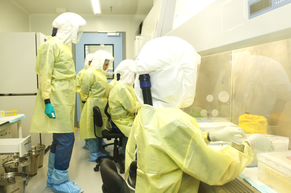
BSL-3 facility.
Theme 1 CollaboratorsExperimental Therapeutics Centre, A*STAR, Singapore)
Department of Pharmacy, National University of Singapore, Singapore
Singapore Eye Research Institute, Singapore
Genome Institute of Singapore, A*STAR, Singapore
School of Biological Sciences, Nanyang Technological University, Singapore
SMART/MIT, Singapore
National University Hospital, Singapore
Harvard University, MA, USA
Public Health Research Institute, NJ, USA
Research projects in Theme 1 are conducted in collaboration with Singapore’s largest research BSL-3 Core Facility at National University of Singapore. It houses a TB Research Laboratory, which is licensed for usage of various mycobacterial strains and animal models. |